

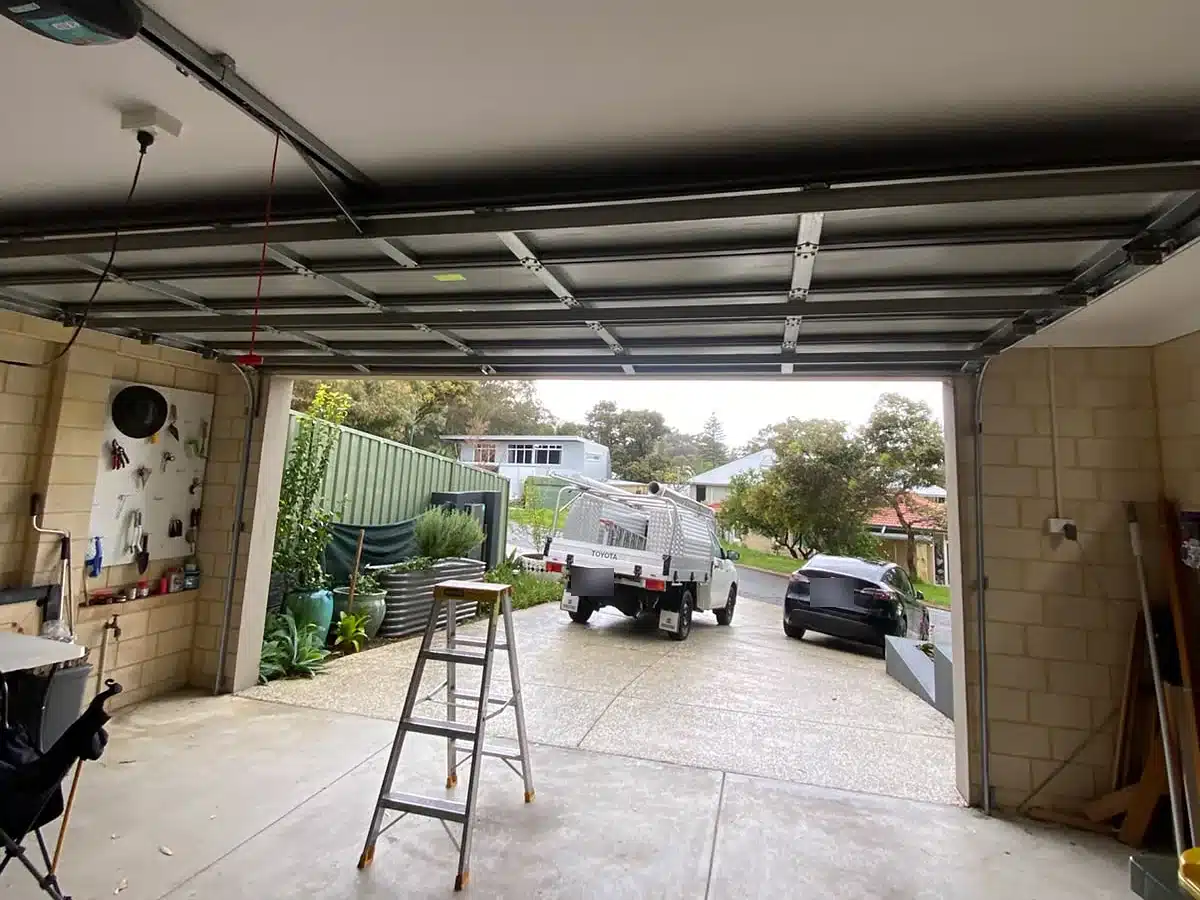
Your garage door starts to close, stops, then trundles back up. You try again. Same result. Or it won’t close at all, and a sensor light blinks at you, usually when you’re already late for the school run. Often, the safety sensors are to blame: the two small units mounted low on either side of the opening.
Many garage door sensor problems take minutes to sort with simple troubleshooting steps and nothing more than a cloth and a screwdriver. This guide covers the fixes you can safely do yourself, and when it’s time to call for help. Safety beam alignment is one of our common call-outs, and we test the safety features on every automatic garage door system we install, so these are the same checks we run on site.
How Garage Door Safety Sensors Work
Garage door safety sensors, also called safety beams, PE beams or photo eyes, are two sensors mounted either side of the door opening, usually 10 to 15cm above the floor. They should sit within about 200mm of the floor, low enough to catch a crawling toddler or a small dog. One sensor sends an invisible infrared beam across the opening, and the receiving sensor on the other side picks it up. As long as the beam is unbroken, the door closes as normal. If anything interrupts it, such as a car, a child, a pet or a bin, the automatic opener stops and reverses the door to prevent accidents. Both sensors are wired back to the garage door opener, which won’t run the door down unless it gets a clear signal from the receiving sensor. Most openers add a second safeguard: the motor senses resistance and reverses if the door touches something.
Each sensor has its own indicator lights. On most sensors, the sending unit shows a steady light when it has power, and the receiving unit shows a steady green light when it can see the beam. Different brands use different colours, so check your opener’s manual, but as a rule a steady light means the sensors are properly aligned and a blinking light means something needs attention. Whether you have a sectional door or a roller door, the principle is the same.
How To Tell The Sensors Are The Problem
Sensor faults tend to show up in predictable ways:
- The door starts to close, then reverses for no visible reason.
- The door won’t close completely with the remote, but closes if you hold the wall button down.
- One light on the sensors is off or blinking.
- The opener clicks or flashes its light when you try to close the door.
- The problem comes and goes, often at the same time each day.
If the door won’t open either, or it’s grinding or shuddering, the issue is more likely the motor, springs or tracks. Stop using the door and book a check of the motor through our garage door motor repairs team.
Why Garage Door Sensors Play Up
Most sensor issues come down to a handful of causes, and the first three are usually quick to fix.
Dirty Or Blocked Lenses
Fine red dust, cobwebs and the odd spider are regulars in Perth garages, and inland suburbs like Ellenbrook and Midland cop more than their share of dust. A dirty lens on either sensor weakens the beam enough to stop the door closing. Bins left out after bin night, boxes or garden tools parked in front of a sensor can block the beam too. So can a dog napping across the doorway.
Sensors Out Of Alignment
Sensors sit on brackets that are easily bumped by a car, a bike or a wheelie bin. If one sensor is knocked even a few millimetres, the beam misses the receiving lens and its light starts blinking.
Sunlight Interference
Low sun can drown out the infrared beam, especially the afternoon sun on west-facing Perth garages. The giveaway is a door that works perfectly in the morning but refuses to close at four o’clock on a summer afternoon.
Wiring Faults
Sensors connect back to the opener with two low voltage wires. Wires that are chewed by mice, pinched near the garage door tracks, corroded or loose at the terminals will break the sensor circuit, and on coastal homes, salt air can corrode connections faster. If both sensor lights are dark, the sensor wiring is the first thing to check.
A Faulty Sensor
Sensors wear out eventually. A cracked or fogged lens, water damage or a failed unit means replacing garage door sensors is the only fix.
How To Fix Garage Door Sensors: Six Checks In Order
Start with the quickest fixes and work down the list.
Step 1: Check The Indicator Lights
Look at the sensor lights on both units. If one light is off or blinking, the problem is likely alignment, a dirty lens or wiring on that side. If both lights are off, check that the opener has power at the power point and look at the wiring connections. If both lights are steady and the door still won’t close, the sensors may not be the problem. Not sure which unit is the sender? Many phone cameras can pick up infrared, so point yours at each lens: the sending lens often shows a faint glow on screen.
Step 2: Clean The Sensor Lenses
Wipe both sensor lenses with a soft dry cloth. Avoid sprays and harsh cleaners that can scratch or fog the lens. While you’re there, clear away cobwebs, checking for redbacks before you reach behind a bracket, and move anything stored near the beams.
Step 3: Align Garage Door Sensors
To align garage door sensors, loosen the wing nut or screw on the sensor bracket, gently swivel the unit until it points straight at its partner, then retighten it. Both sensors should sit at the same height, and a string line tied between the sensor brackets is an easy way to check. Once aligned, both indicator lights should be steady. If a bracket is bent, straighten or replace it so it holds its aim.
Step 4: Shade The Receiving Sensor
If the problem only happens in low sun, shade the receiving sensor. A short length of black conduit or tube fitted over the sensor works well, as long as it doesn’t block the beam. On some systems, the sensors can be swapped so the receiving lens faces away from the sun, but check your manual first.
Step 5: Check The Wiring
Turn off the power at the power point first. Follow the two wires from each sensor back to the opener, looking for cuts, kinks or staples through the cable. At the opener, check that the wires are firmly connected to the correct terminals. On many openers, the sensor cable is a pair of white wires, one often with a black stripe, and they connect to colour-coded terminals such as a white terminal and a grey one.
Step 6: Reset The Opener
Unplug the opener from the power point for about a minute, then plug it back in. Disconnecting the power can reset the system and clear a stored fault. Then run the door through a full cycle to make sure it’s working properly. If the fault returns, note when, and what the lights are doing. That pattern saves a technician time.
The Two-Minute Safety Test
Safety features only help if they still work. Open the door, start closing it and pass a broom handle or a box through the beam. The door should stop and reverse straight away. If it doesn’t, stop using the automatic opener until the fault is fixed. As part of proper maintenance, we recommend this two-minute test once a month and after any power cut or opener reset. If your opener auto-closes on a timer, test more often, because the beams are what’s watching the doorway. If you have little ones, also mount the wall button at least 1.5 metres up, and read our guide to keeping your garage door safe around children for more ways to prevent accidents.
Can You Bypass Garage Door Sensors?
A common search is how to bypass garage door sensors temporarily so the door will close. We understand the temptation, especially at 10pm with the door stuck open. Please don’t. Safety sensors are there to stop the door closing on people, pets and cars, and bypassing them makes your automatic garage door system unsafe. One toddler chasing a ball is all it takes for that shortcut to end badly. An opener without working sensors or auto-reverse also won’t meet the current Australian standard, AS/NZS 60335.2.95, which we fit every opener to.
If you need to close the door before the sensors are fixed, many openers will close the door if you press and hold the wall button until it’s fully down, while you keep a clear view of the opening. That works because you’re watching the doorway, so the opener treats it as supervised operation. Alternatively, pull the manual release while holding the door, lower it slowly by hand and lock it. Leaving the door open overnight is a security risk, so fix or replace the faulty sensor as soon as you can.
When To Replace Garage Door Sensors
A garage door sensor replacement is the right call when:
- Both lights stay dark even though the wiring and power are fine.
- A lens is cracked, fogged or water damaged.
- The sensors are old and the fault keeps coming back.
Replacement sensors must match your opener brand and its generation, because sensors from a different system usually won’t talk to it. For example, Steel-Line openers need sensors made for that system, which our Steel-Line garage door openers page covers. Our vans are stocked with parts for the brands most commonly installed across Perth, so it’s usually a quick job, safety test included. Some older openers have no beams at all, and if yours can’t take add-on beams, upgrading the opener is the safer fix.
Expert Tips
Maintenance tip: keep the lenses clean by wiping them with a soft dry cloth every month or two, especially in summer when dust builds up.
- Keep the area in front of the two sensors clear of bins, boxes and bikes.
- Check the brackets are tight whenever you clean the lenses.
- Deal with a blinking light early, before the door stops closing altogether.
- If your retic sprays across the driveway, angle the sprinklers away from the sensors, because water damage can kill a sensor.
Quote tip: when you book a technician, ask whether the call out fee is included in the quote and whether replacement sensors are carried in the van, so the job can be finished in one visit. We give a clear quote before any work begins.
When A Technician Should Take Over
If you’ve cleaned, aligned and checked the wiring and the door still won’t close, it’s time for professional garage door repairs. Call us if:
- The sensor lights stay off even with power.
- Wiring needs replacing inside the walls or ceiling.
- The door reverses even when the beam is clear.
- The door is noisy, uneven or has come off its track. Our guide to a garage door off its track explains why that needs urgent attention.
Our approach starts with what the door is doing, not what the caller thinks is broken. A door that reverses with a clear beam, for instance, may have a force setting, spring or track problem rather than a sensor fault. With sensors and opener parts in the van, we can usually finish the repair the same day. If your door is stuck open overnight, our emergency garage door repair service runs 24/7, and any after-hours call out fee is explained before work begins.
Frequently Asked Questions
Here are quick answers to common questions about garage door sensors.
How Long Do Garage Door Sensors Last?
Garage door sensors typically last 10 to 15 years with proper maintenance. Harsh Perth sun, moisture and knocks from cars and bins can shorten that.
Can I Replace Garage Door Sensors Myself?
If you’re comfortable with low voltage wiring, it’s possible, but the new sensors must match your opener. A technician can confirm compatibility and test the safety function properly.
Get Your Garage Door Closing Properly Again
In most cases, learning how to fix garage door sensor faults comes down to five things: check the lights, clean the lenses, align the sensors, shade them from the sun and check the wiring. If the door still won’t close, don’t bypass the sensors. Have a professional find the fault.
A door that won’t close is more than an annoyance, because it leaves your home open. Our founder, Tyler Gefterman, started Slide & Glide to help people feel safe and supported “in those stressful moments when a garage door or gate stops working and your home isn’t secure.” We repair garage door sensors, openers and safety beams from Joondalup to Fremantle, with technicians on call 24/7 for emergencies. Book a repair or call 0489 266 468, and we’ll get your door closing properly again.

- How To Tension A Roller Door (And When To Call A Pro) - October 18, 2026
- How To Program A B&D Garage Door Remote - October 18, 2026
- How Long Do Garage Doors, Motors And Springs Last? - October 18, 2026
Social Media